
Nearly 40% of Canadian marriages that started in the 2000s are projected to end in divorce within 30 years (Statistics Canada, 2022). If you’re one of them, you already know that splitting up is painful. Add a shared home to the mix, and things get complicated fast.
For most Winnipeg couples, the family home is the single largest asset they own together. With the average Winnipeg home valued at $383,977 in January 2026 (WOWA.ca, 2026), a 50/50 split means roughly $192,000 per person — before mortgage payoff. That’s life-changing money tied up in walls and a roof.
This guide walks you through Manitoba’s specific laws, your four options for the marital home, and the fastest way to sell and move forward. No fluff, no legal jargon you can’t understand — just the facts you need right now.
Key Takeaways
- Manitoba’s Family Property Act gives both spouses an equal 50/50 share of the marital home — regardless of whose name is on the title.
- The Homesteads Act requires written spousal consent before any sale can go through.
- You have 4 main options: mutual sale, spousal buyout, deferred sale, or selling to a cash buyer.
- Without a signed separation agreement, your lawyer holds all sale proceeds in trust — you can’t access your share until the division is resolved.
- A cash sale can close in as few as 7 days, letting both parties move on without months of showings and open houses.
What Does Manitoba Law Say About Selling Your Home During a Divorce?
Under Manitoba’s Family Property Act (CCSM c F25), both spouses are entitled to an equal 50/50 share of all family property acquired during the marriage (Government of Manitoba). This isn’t a suggestion. It’s the law — and courts rarely deviate from it.
So what counts as “family property”? Pretty much everything you and your spouse acquired while married and living together. The house, the vehicles, savings, investments — all of it gets split down the middle.
Here’s what catches many people off guard: it doesn’t matter whose name is on the title. Even if only one spouse is listed as the owner, the other spouse still has a legal right to half the value.
Does This Apply to Common-Law Couples?
Yes. Since June 30, 2004, Manitoba extended these same property rights to common-law partners who’ve cohabited for three or more years or registered their relationship (Government of Manitoba). That means common-law breakups follow the same 50/50 division rules as married couples.
The law also recognizes that both homemaking and income-earning contribute equally to the marriage. A stay-at-home parent has the same property rights as the spouse who worked outside the home.
Can a court order an unequal split? Technically, yes — but only in exceptional circumstances. Judges have very limited discretion here, and most divorces in Manitoba result in an even division.
Do You Need Your Spouse’s Consent to Sell the House?
Yes — and this is one of the most important things to understand. Under Manitoba’s Homesteads Act, the non-owning spouse must provide written consent before the family home can be sold or mortgaged (Government of Manitoba). No exceptions to this without a court order.
This means you can’t just list the house and sell it on your own, even if your name is the only one on the title. Your spouse has to sign a formal Homestead Consent Form — a legal requirement that protects both parties. Before signing anything, make sure you also understand how to avoid liens and other title issues when selling for cash.
What If Your Spouse Refuses to Sign?
If your spouse won’t consent, you’re not completely stuck. You can apply to the Manitoba Court of King’s Bench to dispense with the consent requirement. The court will consider factors like:
- Whether the sale is in both parties’ best interest
- Whether children are affected
- Whether the refusing spouse has a valid reason
This process takes time and costs money. A real estate appraisal alone runs $400 to $1,500 in Manitoba (divorce.law, 2025), and you’ll need a lawyer to make the application. That said, courts generally side with the spouse who wants to sell — unless there’s a good reason not to.
What Are Your 4 Options for the Marital Home?
Divorcing couples in Winnipeg have four main paths for dealing with their home. With the average Winnipeg home price at $383,977 (WOWA.ca, 2026), the choice you make has a major financial impact.
Option 1: Mutual Sale (List and Split)
Both spouses agree to list the home, sell it on the open market, and split the proceeds 50/50. This is the cleanest option — but it requires cooperation. You’ll both need to agree on a listing price, a real estate agent, showing schedules, and an offer. A traditional sale in Winnipeg typically takes 3 to 6 months from listing to closing.
The upside? You’ll likely get market value. The downside? Months of strangers walking through your home while you’re going through one of the hardest experiences of your life.
Option 2: Spousal Buyout
One spouse keeps the home by refinancing the mortgage in their name alone and paying the other spouse their equity share. If the home is worth $383,977 with a $200,000 mortgage remaining, the buying spouse would owe roughly $92,000 to the other.
This only works if one spouse can qualify for the full mortgage on a single income. That’s a big “if” for many couples. The process typically takes 2 to 4 months to arrange financing and complete the transfer.
Option 3: Deferred Sale
Both spouses agree to postpone the sale — often until the youngest child turns 18 or finishes school. One spouse stays in the home. This sounds nice for the kids, but it complicates finances for years. You’re still tied to your ex through a shared mortgage and a shared asset. Not exactly a clean break.
Option 4: Sell to a Cash Home Buyer
The fastest option. A cash buyer makes an offer (usually within 24 hours), and closing can happen in as few as 7 to 14 days. No repairs, no showings, no realtor commissions. Both spouses agree to the offer, sign at closing, and walk away.
This works especially well during a divorce because there’s minimal contact required between spouses, no open houses to coordinate, and no risk of a buyer’s financing falling through three months into the process.
| Option | Typical Timeline | Requires Cooperation? | Costs |
|---|---|---|---|
| Mutual Sale (MLS) | 3–6 months | Yes — ongoing | Realtor fees (5%), repairs, staging |
| Spousal Buyout | 2–4 months | Yes — initial | Appraisal, legal, refinancing |
| Deferred Sale | Years | Yes — ongoing | Shared mortgage, maintenance |
| Cash Buyer | 7–14 days | Minimal | No fees, no repairs |

What This Actually Looks Like in Practice
I recently worked with a couple where both parties were cooperating — which made things smoother, but it still took about three months from our first conversation to closing. The husband was my main point of contact, and both spouses already had their own lawyers in place when I got involved.
Here’s what slowed things down: when I wrote the offer to purchase, it went to the husband first, then to his lawyer, then to the wife’s lawyer, and finally to the wife herself. They couldn’t communicate directly — everything went through this chain of filters. If the husband liked the price and terms but the wife didn’t, the whole thing had to go back through the same chain. Back and forth, layer by layer.
That communication filter is the tough part. It takes patience. Once both parties agreed on the terms, it became a waiting game — but getting to that point is where the real work happens. And this was a cooperative situation. When there’s disagreement and high emotions involved, it can stretch out much longer. If you’re in this situation, just know that patience is part of the process.
What Happens to the Sale Proceeds Without a Separation Agreement?
This is the part nobody tells you about — and it’s a big deal. Without a signed separation agreement, the real estate lawyer handling your sale is legally required to hold all proceeds in trust (Fairway Divorce). Neither spouse gets a penny until the property division is legally resolved.
Think about that for a moment. You sell your home, the sale closes, and you still can’t access your share of the money. It sits in a trust account while you and your ex work out the details — which could take months or even years if the divorce is contested.
How Much Does the Divorce Itself Cost?
An uncontested divorce in Manitoba runs $1,500 to $3,000. But if things get contested? Legal fees jump to $7,500 to $25,000 or more. Complex cases with disputes over property and custody can exceed $50,000 (divorce.law, 2025).
That’s why getting a separation agreement in place before selling is so important. It doesn’t have to be complicated — a lawyer can draft one that covers the property division specifically. Just don’t try to do it yourself on a napkin. Banks and real estate lawyers usually won’t accept informal or DIY agreements (Fairway Divorce).
Here’s the strategic play: pair a separation agreement with a fast cash sale. Get the agreement signed, sell to a cash buyer who closes in 7 to 14 days, and both spouses walk away with their share immediately. No trust account limbo. No waiting.
Can a Court Force You to Sell Your House in a Divorce?
Yes. If you and your spouse can’t agree on what to do with the home, Manitoba courts can order the sale — and the bar for the other spouse to block it is very high. The person opposing the sale must demonstrate that the request is “malicious, vexatious, or oppressive” (separation.ca).
In practice, courts almost always approve the sale. They can:
- Set the listing price based on an independent appraisal
- Appoint a real estate agent if the spouses can’t agree on one
- Grant one spouse sole conduct of the sale — meaning they handle everything
- Set terms for showings and access to the property
The court’s primary concern is fairness to both parties and, if children are involved, their best interests. A contested divorce that reaches trial in Manitoba can take 2 to 4 years (mhlaw.ca, 2025). That’s two to four years of legal fees, shared mortgage payments, and emotional weight.
Want to avoid all of that? Agree on a sale now. A cash offer takes one meeting, one signature from each spouse, and it’s done.
When One Spouse Doesn’t Want to Sell
I’ve been in situations where one spouse wants to sell and the other doesn’t — and I end up being the person in between. This happens especially when the couple hasn’t hired lawyers yet, because divorce lawyers are expensive and they’re trying to figure things out on their own first.
When I step into that situation, it gets complicated fast. I’m dealing with both parties at the same time, and the emotions are real. One spouse might be dragging their feet for financial reasons — maybe they want to keep the property for themselves, or they think they’ll get a better deal later. The other spouse just wants it done.
Every situation is different. Sometimes the holdout has a legitimate interest in keeping the home. Sometimes it’s about leverage in the broader divorce negotiation. These are the things you have to account for when you’re dealing with a divorce sale — it’s never just about the house. There are competing interests, and you have to navigate all of them to reach a fair outcome.
How to Sell Your Winnipeg Home Fast During a Divorce
About 25% of divorced households in Canada experience housing instability — including temporary homelessness or overcrowded living situations (worldmetrics.org, 2024). Speed matters. The faster you sell, the faster both parties can secure stable housing.
Selling to a cash home buyer is the most straightforward path during a divorce. Here’s how it works with We Buy Houses Winnipeg:
Step 1: Contact us. Call or fill out the form. Tell us about the property and your situation. We’ve worked with divorcing couples before — nothing you share will surprise us.
Step 2: Get a fair cash offer. We’ll assess the property and make an offer, usually within 24 hours. No obligation. No pressure.
Step 3: Choose your closing date. You pick the timeline that works for both parties — as fast as 7 days, or longer if you need time to arrange your next move.
Step 4: Close and move on. Sign the paperwork, receive your funds, and start the next chapter.
Why This Works During a Divorce
- No showings or open houses. You don’t need to keep the house spotless while your life is in turmoil.
- No repairs or staging costs. We buy homes as-is — the condition doesn’t matter.
- No realtor commissions. That’s 5% you keep. On a $383,977 home, that’s over $19,000 saved. Here’s a full breakdown of the costs of selling to a cash buyer in Winnipeg.
- Minimal contact between spouses. We can work with both parties separately if needed.
- No financing risk. Cash means the sale doesn’t fall through because a bank says no. And if you’re wondering about inspections, here’s what to expect from a cash buyer home inspection.
If you’re ready to explore this option, reach out to us for a no-obligation conversation.
Sometimes People Just Need Someone to Talk To
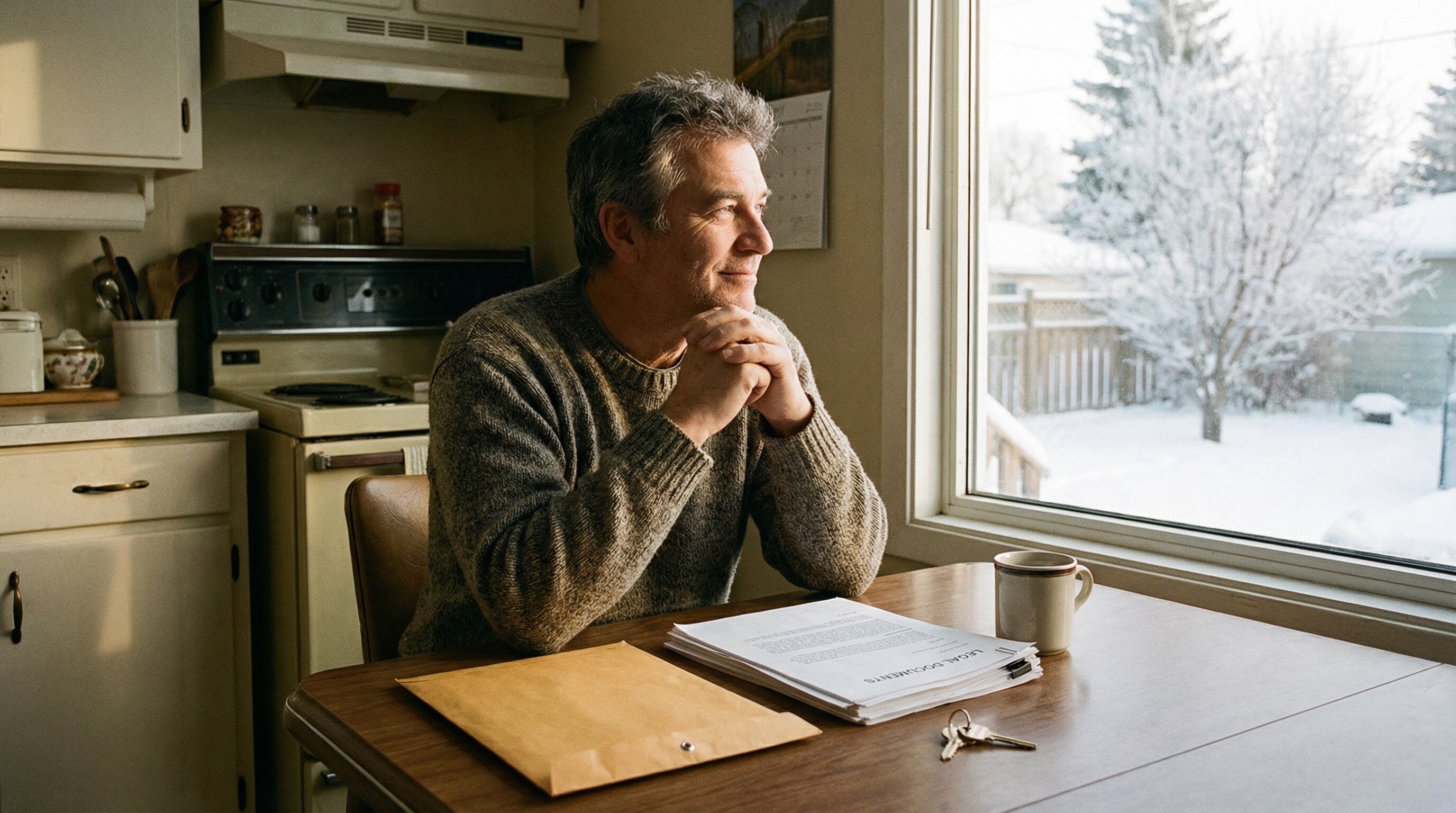
One thing I’ve learned doing this work — when someone going through a divorce calls about selling their house, they’re usually not just calling about the house. They’re stressed about everything. The kids, the new household dynamics, the finances, the other assets. Everything is changing at once, and they need someone to talk to who can help them figure out at least one piece of the puzzle.
The house is usually the biggest asset they’ll deal with in the divorce. So when we sit down and map out a strategy — just for the house — there’s a visible sense of relief. They finally have a plan for at least one major thing on their plate.
When the situation is really complicated, I’ll recommend they get lawyers involved first, for both parties. And sometimes the lawyers actually prefer having a realtor in the picture too, because it keeps the property side clean and separate from the rest of the divorce. I can bring in a trusted realtor to give them a professional recommendation — whether that’s listing on the market or doing an as-is cash sale. Either way, they walk away knowing their options and feeling like they’ve got some control back.
What About Taxes When Selling During a Divorce?
Good news here. The sale of your principal residence is tax-free in Canada under the Principal Residence Exemption (PRE) (CRA Income Tax Folio S1-F3-C2). If the home you’re selling has been your primary residence, you won’t owe capital gains tax on the sale.
After separation, the CRA recognizes two separate households. That means each ex-spouse can designate one property as their principal residence going forward.
There’s another tax benefit worth knowing. If property is transferred between spouses as part of a divorce settlement (instead of sold), it happens at the adjusted cost base — meaning no capital gain is triggered at the time of transfer. This is a rollover provision under Canada’s Income Tax Act.
One important note: these are general rules. Your specific situation may vary, especially if the property was used as a rental or if there are other assets involved. Talk to a tax professional or accountant before making decisions. This isn’t tax advice — it’s a starting point.
Frequently Asked Questions
Can I Sell My House Before the Divorce Is Final in Manitoba?
Yes. You don’t have to wait for the divorce to be finalized. However, both spouses must agree to the sale, or you’ll need a court order. Manitoba requires a one-year separation period before a divorce can be granted, but property can be sold during that time. The court filing fee is $200 (divorce.law, 2025).
How Long Does a Divorce Take in Manitoba?
An uncontested divorce takes about 2 to 4 months after filing. Contested divorces range from 1 to 4 years, depending on complexity. If it goes to trial, expect 2 to 4 years. The average Canadian marriage lasts 15.3 years before divorce (nussbaumlaw.ca, 2024).
Do I Need My Spouse’s Permission to Sell the House?
Yes. Under Manitoba’s Homesteads Act, written spousal consent is required before selling the family home — even if only one spouse is on the title. If your spouse refuses, you can apply to the Court of King’s Bench to override the refusal.
How Are Divorce Sale Proceeds Divided in Manitoba?
The default is a 50/50 split under the Family Property Act. Courts rarely deviate from equal division unless there are truly exceptional circumstances. This applies to both married and common-law couples (3+ years cohabiting).
Can I Sell to a Cash Buyer During a Divorce?
Absolutely — and it’s often the fastest way to resolve the property question. Both spouses agree to the cash offer, closing happens in 7 to 14 days, and each party receives their share. There are no realtor commissions, no repair costs, and no months of waiting.
What If My Ex Won’t Agree to Sell?
You can apply to Manitoba’s Court of King’s Bench under the Family Property Act. The court can order the sale, set the listing price, appoint an agent, and even grant one spouse sole authority to manage the process. The spouse opposing the sale must prove the request is malicious or oppressive — a very high bar.
Moving Forward
Divorce is hard enough. Selling your home doesn’t have to make it harder.
Here’s what you now know:
- Manitoba law gives both spouses a 50/50 share of the family home under the Family Property Act
- Written consent is required from both spouses before any sale (Homesteads Act)
- You have 4 options — and a cash sale is the fastest at 7 to 14 days
- Without a separation agreement, proceeds get locked in trust — so get one before selling
- Courts can force a sale if you and your spouse can’t agree
- The sale of your principal residence is tax-free under the PRE
If you’re going through a divorce and need to sell your Winnipeg home, we can help. We’ve worked with couples in exactly this situation — no judgement, no pressure, just a fair offer and a fast closing.
Get a free, no-obligation cash offer today →
Or call us directly. We’ll walk you through the process and answer any questions — even if you’re not ready to sell yet. Sometimes it helps just to know your options.
Renz Javing is the owner of We Buy Houses Winnipeg, helping homeowners sell their properties fast for cash since 2026. He works directly with sellers facing divorce, foreclosure, inherited properties, and other life changes across Winnipeg and surrounding areas.
